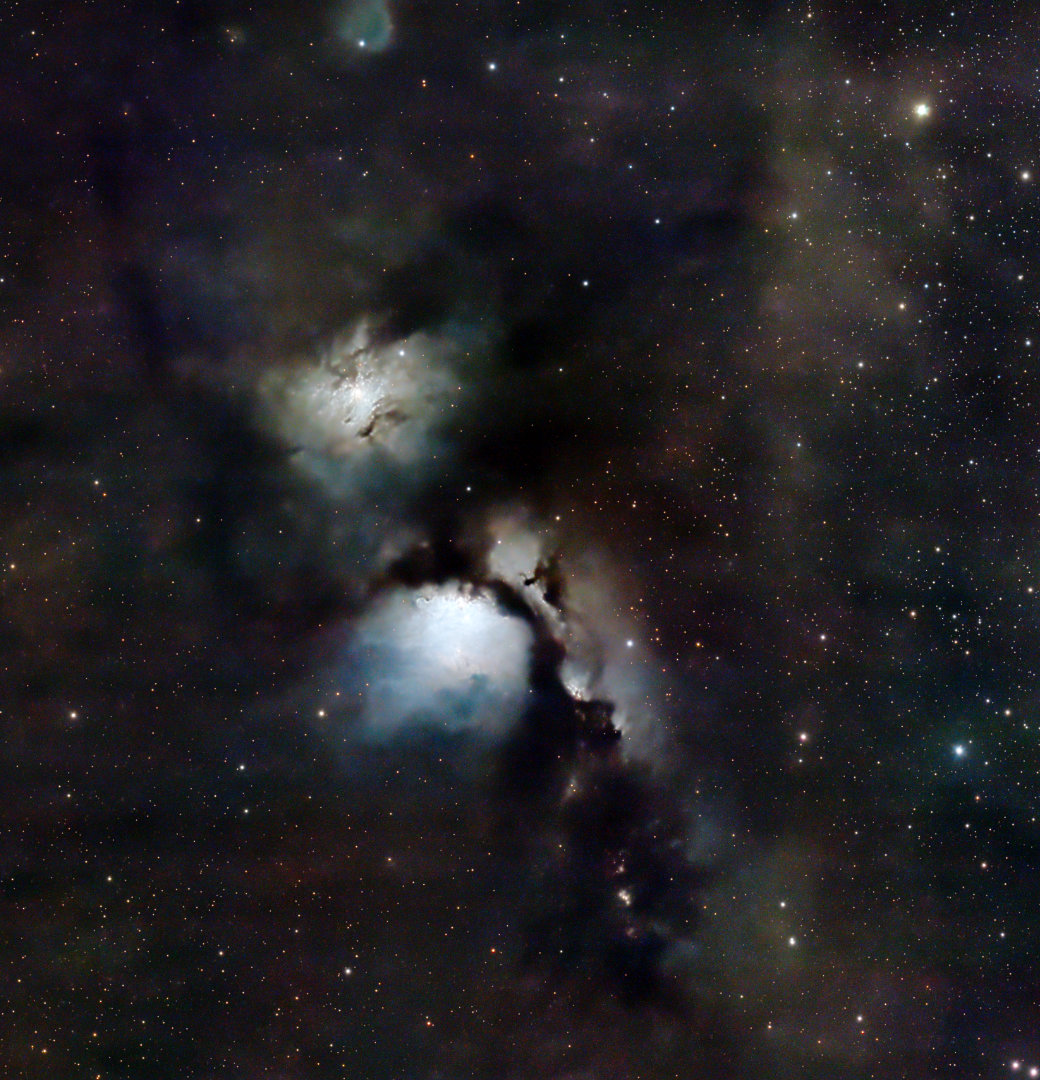
This section of the sky looks stormy, with bright nebulae partially hidden behind thick expanses of dark dust. The whole scene reminds me of flashes of lightning glowing inside dark clouds on a stormy night.
The main features are M78 and NGC 2067—bright, bluish-white glowing dust clouds separated and surrounded by dark, dense lanes of cosmic dust. Several sources call M78 the “Casper the Friendly Ghost Nebula.”
This is a busy section of the night sky#
M78, NGC 2067 and NGC 2064 are actually all part of the same cloud of gas and dust, lit up by nearby hot, young stars. An intervening ribbon of dark dust cuts right across the front, making it appear split in two. This dark cloud extends through, around, and far beyond the edges of this frame. Just above them, NGC 2071 is a similar—though separate—nebula.
The bluish tint you see comes from starlight scattering off microscopic dust grains—the exact same physics that makes our daytime sky blue.
Nearby, Bernes 100 is a fascinating object that remains largely unstudied by professional astronomers. It has a distinct horseshoe, or “head-and-tail,” shape. Its southern rim glows red where energetic stellar winds slam into surrounding gas, while its blue interior is lit by the star sitting right on its southern edge. One of my reference books notes that it “may have one of the highest ratios of times imaged—potentially hundreds of thousands—to the number of times it appears in scientific literature: three.”
More M78 and neighbors trivia#
- Apparent size: If the full Moon were placed here, it would just barely cover the pair of M78 and NGC 2071.
- Actual size: About five light-years across.
- Distance: All of these nebulae are roughly 1,350 light-years away, so the light my camera captured was emitted in the middle of the Dark Ages.
- How bright: M78 is visible as a faint smudge of light in binoculars and small telescopes, though it is too dim for the unaided eye.
- Where to find it: It is located in the constellation Orion (the Hunter).
- Discovery: M78 was discovered by Pierre Méchain in 1780 and cataloged by Charles Messier that same year. NGC 2071 was discovered by William Herschel in 1784.
Pareidolia#
You may recall that I discussed pareidolia—the brain’s tendency to see familiar shapes in random patterns—here. As I mentioned above, what my subconscious sees in this image is a dark and stormy sky. Some observers see two dark “eyes” inside M78 with a wispy ghostly tail trailing off, which is how it earned the nickname “Casper the Friendly Ghost,” though I’m mostly at a loss to see it myself.
I’d love to hear what your subconscious sees!
Imaging Details#
Celestron RASA 8 telescope, ZWO ASI183MC one-shot color camera, 239 individual 30-second exposures stacked together for 120 minutes of total integration time. Captured November 11, 2026 under suburban (Bortle 6) light-polluted skies. Processed using Siril, Syqon, and Affinity software.
Since the images in this blog are relatively large and contain a lot of detail, if you are using a phone or a small tablet, you might want to consider returning sometime when you can use a computer with its larger screen.