The Hidden Galaxy (IC 342) is one that we see despite its being shrouded behind a milky veil.
It is a large face-on spiral that happens to lie behind the thick dust, gas, and stars of the Milky Way’s disk, which greatly dims its visible light.
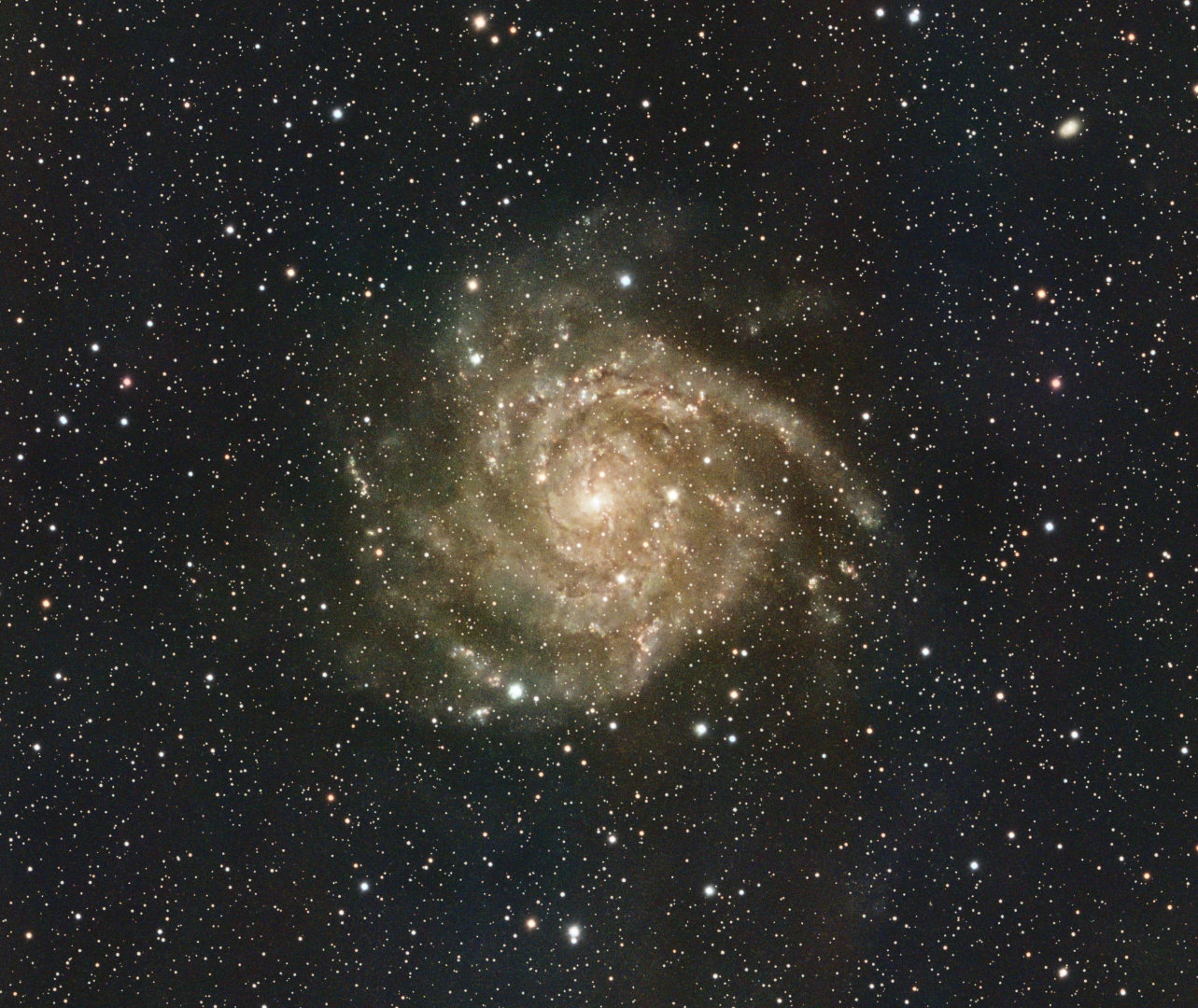
Unlike most galaxy photos where we see only a few stray stars here and there, this image is packed with hundreds of stars scattered across the entire frame. Every single one of those pinpoint stars belongs to our own Milky Way—we are essentially peering through a crowded foreground window to catch the faint spiral arms behind them. Because the dust dims the galaxy so heavily, it took nearly five hours of total camera exposure to bring out its delicate structure.
If the foreground between Earth and IC 342 weren’t so busy and full of matter, the Hidden Galaxy would no longer be hidden and would be one of the brightest galaxies in our night sky.
More IC 342 trivia#
- Surprisingly large: Although faint because of dimming dust, it actually spans a huge patch of sky—roughly half to two-thirds the apparent width of the full Moon.
- A close neighbor: It sits about 11 million light-years away (relatively close on a cosmic scale) and measures roughly 150,000 light-years across, making it somewhat larger than our own Milky Way.
- Where to find it: It is located in the northern constellation Camelopardalis (the Giraffe).
- 19th-century discovery: It was discovered in 1892 by William Denning, a prominent British amateur astronomer.
- Why it’s an “IC” object: Early astronomers missed it when compiling the famous New General Catalogue (NGC) using visual telescopes alone. It wasn’t caught until the dawn of long-exposure astrophotography, earning it a spot in the supplemental Index Catalogue (IC)—where it holds the title of the largest galaxy by apparent size.
Imaging Details#
Celestron RASA 8 telescope, ZWO ASI183MC camera, 560 × 30-second exposures stacked together to give 280 minutes of total integration time, captured November 9, 2026 under Bortle 6 skies. Processed using Siril, Syqon and Affinity software.
Since the images in this blog are relatively large and contain a lot of detail, if you are using a phone or a small tablet, you might want to consider returning sometime when you can use a computer with its larger screen.