The Lagoon Nebula, also known as M8, is one of the highlight objects of the night sky – a remarkable region where new stars are being formed. The nebula glows as its gas is energized by the intense radiation from nearby young stars.
Across this glowing landscape, dark lanes of dust divide the nebula into regions that resemble a lagoon separated from the ocean by a sandbar.
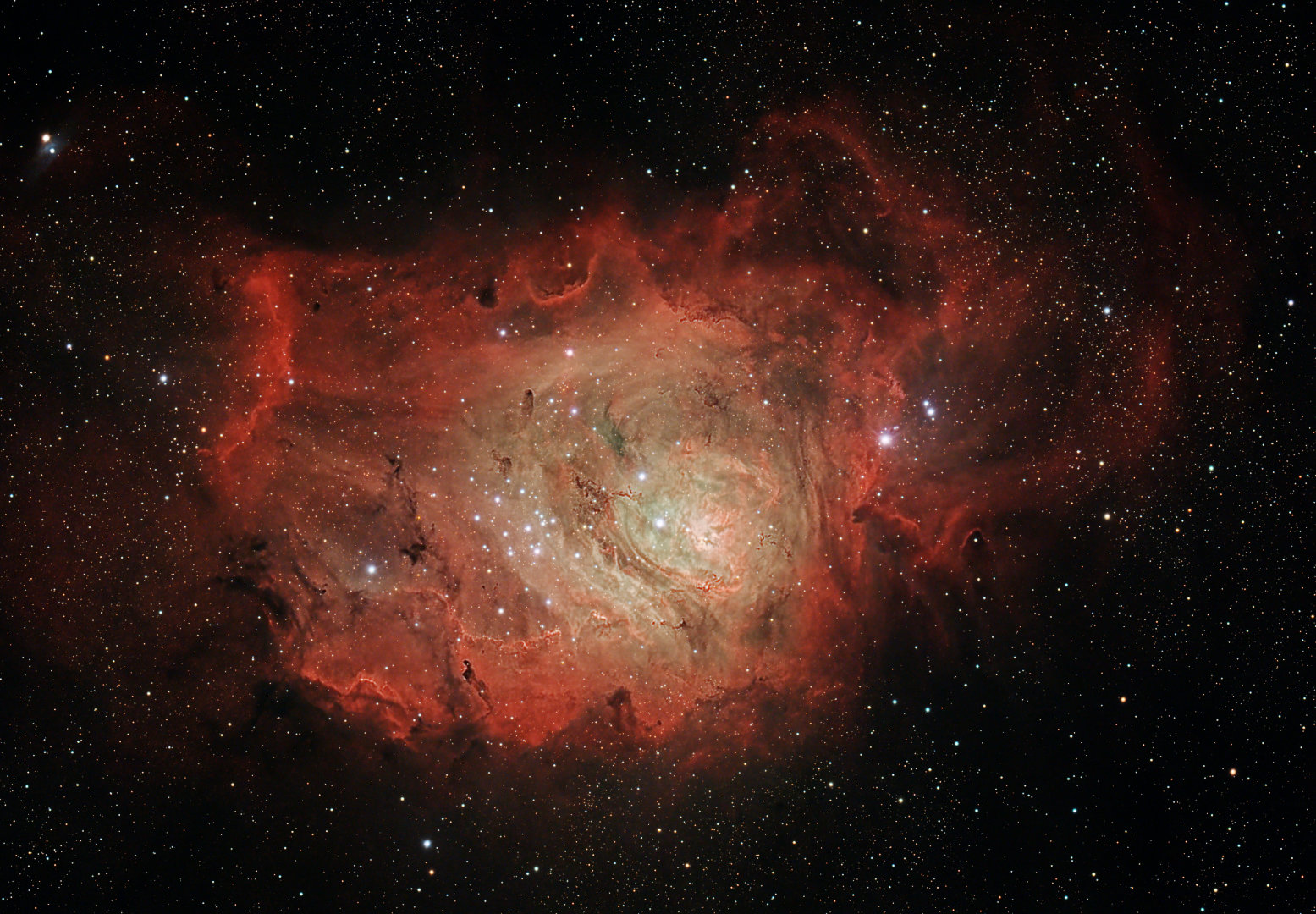
The dark knots in the image are called Bok globules. They are dense concentrations of gas and dust that can collapse under their own gravity to form stars. Some contain the raw material for multiple stars. Three of the larger ones, B88, B89 and B296 are pointed out in the notations, but you will see a large number of smaller ones as well.
The massive stars of open cluster NGC 6530 were formed from the nebula’s material and flood the surrounding gas with ultraviolet radiation. This ionizes the gas and causes the eastern (left) side of the nebula to glow brightly in shades of red and pink. Several other similar stars do the same for the western (right) side.
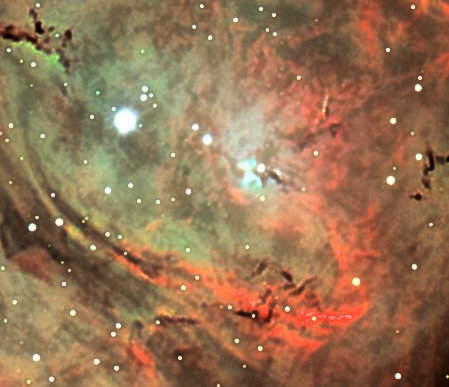
Deep within M8 is a particularly bright region known as the Hourglass Nebula. It is a compact area of active star formation, illuminated by a young, massive star. Although you can make it out in the main image above, here is a slightly enlarged section of the image centered on the Hourglass that I have processed a little differently to reveal it better. The Hourglass is a fascinating example of how stars can be born inside a much larger cloud of gas and dust.
The Lagoon Nebula is being reshaped by its own newborn stars -- they do more than illuminate the nebula. Their intense radiation and stellar winds erode the surrounding gas and dust, sculpting the cloud into the structures we see today.
More Lagoon Nebula trivia#
- The Lagoon lies in the constellation Sagittarius (the Archer).
- The full extent of the Lagoon Nebula covers about three times the area of the full moon.
- The distance to the Lagoon Nebula is variously quoted as being between 4100 and 5200 light years.
- Visible to the naked eye as a faint blob, it was first described in 1654 by the Sicilian astronomer Giovanni Battista Hodierna. The name Lagoon was first bestowed by Agnes Clerke in 1890.
- The stars in NGC 6530 were formed from the material inside the nebula, its age is placed at roughly 1 to 2 million years. The nebula continues to give birth to new stars, meaning the gas cloud itself has been fueling star creation for millions of years.
- IC 4678, a small reflection nebula, is a faint extension of the main Lagoon Nebula cloud, spanning roughly 25 light-years across.
Pareidolia#
You may recall that I discussed the word pareidolia here.
My first impression of the dark lagoon reminded me of one of those air-driven figures that you see wriggling to advertise places like used car lots!
But when I look at this image of the Lagoon Nebula, I can’t shake the impression that I’m looking through a hole in the sky and seeing a dizzying view of the stomach and guts of the universe.
What do you see?
Imaging Details#
Celestron RASA 8 telescope, ZWO ASI183MC camera, 240 × 30-second exposures stacked together to give 120 minutes of total integration time, captured July 16, 2026 under Bortle 6 skies. Processed using Siril, Syqon and Affinity software.
Since the images in this blog are relatively large and contain a lot of detail, if you are using a phone or a small tablet, you might want to consider returning sometime when you can use a computer with its larger screen.