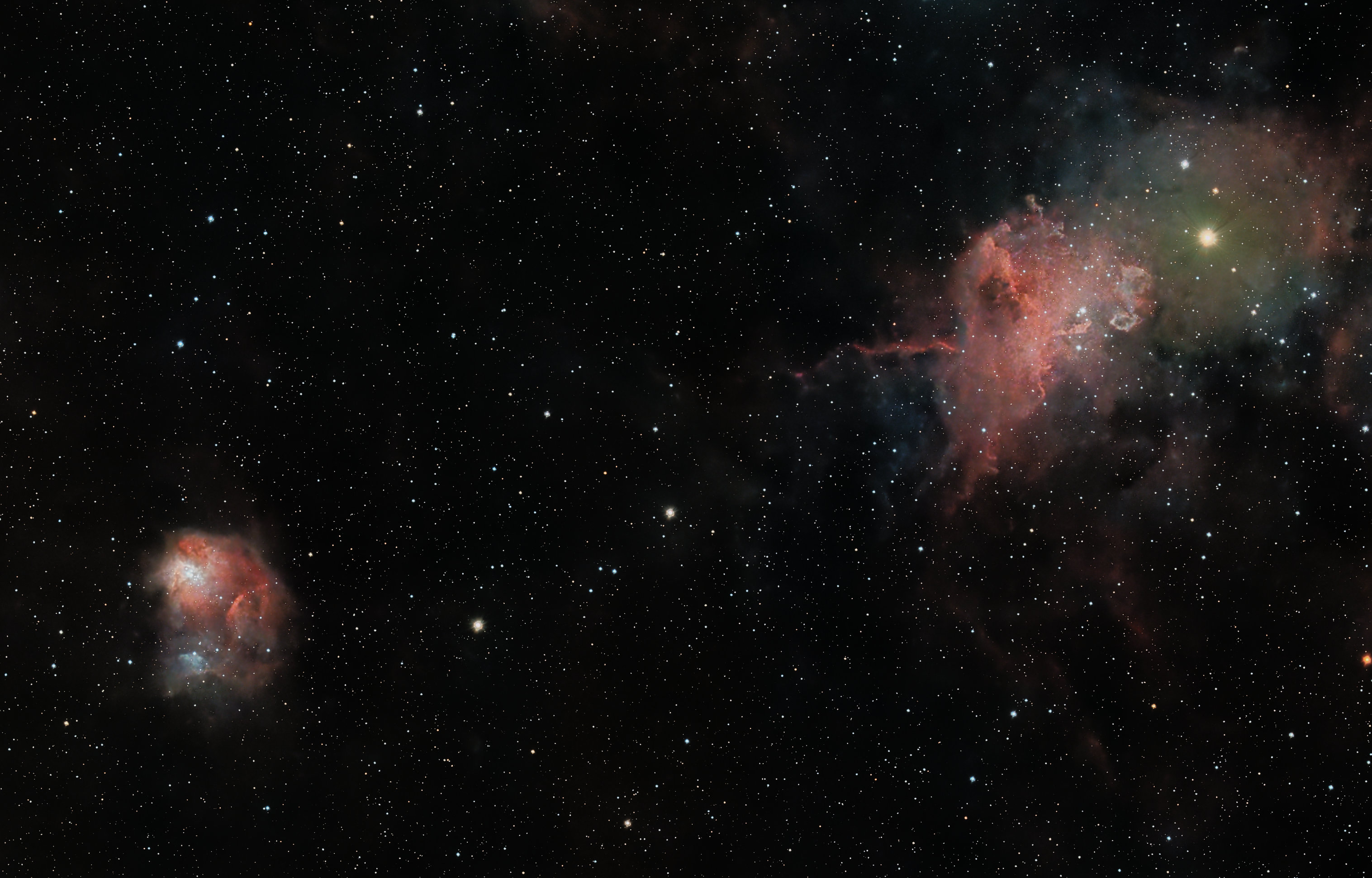
The Spider and the Fly are a stunning pair of neighboring star-forming nebulae and open star clusters in the constellation Auriga.
Both are active stellar nurseries where massive, newly formed stars ionize the surrounding gas and dust clouds. They lie in the Milky Way’s outer regions, in a part of the sky rich in star-forming nebulae.
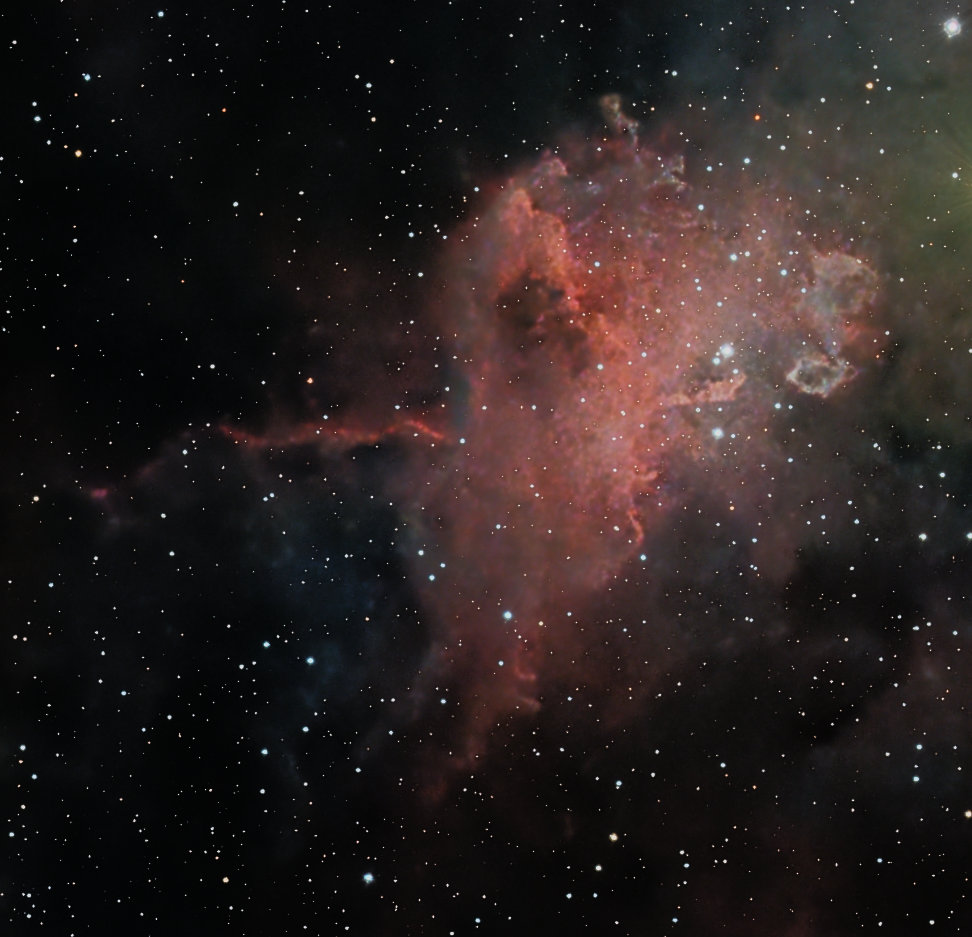
The Spider Close-Up#
And the Fly Close-Up#
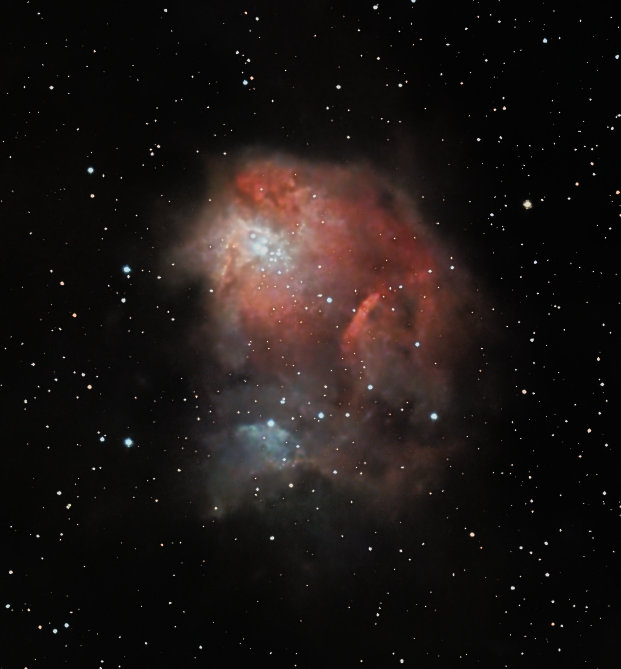
Notice that in addition to the red emission glow from excited hydrogen atoms we also see patches of blue which is starlight scattered by dust.
Spider and Fly Trivia#
Sky Constellation: Auriga (The Charioteer)
IC 417 — The Spider
- Contains a young open star cluster called Stock 8 near its center. Its stars are estimated to be less than 3 million years old—an eye-blink in cosmic terms.
- Measures about 26 light-years in diameter and lies approximately 7,000 light-years from Earth. However published estimates vary between 6,700 and 10,000 light years.
- Spans a little less than half the Moon’s apparent diameter, though it is vastly fainter.
- Discovered by German astronomer Max Wolf on September 25, 1892.
NGC 1931 — The Fly
- Often described as a “miniature Orion Nebula” because of its compact structure and the fact that it features its own tight, compact “Trapezium” cluster of hot young stars carving out a glowing cavity.
- Measures about 10 light-years across and lies approximately 7,500 light-years away.
- Spans roughly one-fifth of the Moon’s apparent diameter, although again it is vastly fainter.
- Discovered by Englishman William Herschel on February 4, 1793.
Imaging Details#
Celestron RASA 8 telescope, ZWO ASI183MC camera, 439 × 30-second exposures stacked together to give 220 minutes of total integration time, captured October 8, 2026. Processed using Siril, Syqon and Affinity software. The close-up images are crops of the full image and show the full resolution captured by the camera. (This 3.7-hour exposure is longest I have taken and published up to now – longer exposures capture more detail.)
Pareidolia#
The IC 417 emission nebula features long, wispy filaments that evoke spider legs—or perhaps threads of a cosmic spider web. However, seeing a fly in NGC 1931 takes a bit more imagination. What do you see?
More about the word pareidolia here.
Since the images in this blog are relatively large and contain a lot of detail, if you are using a phone or a small tablet, you might want to consider returning sometime when you can use a computer with its larger screen.